Ratings Management Services2026-08-03T14:05:02+00:00

Systematic Ratings Management

Systematic Ratings Management

Take control of how you are ranked.

Ratings and rankings shape your reputation whether you manage them or not. Systematic ratings management replaces scattered, case-by-case efforts with clear priorities, accountability, and oversight, focused on the ratings and rankings that count.

Ratings simplify a complex world

Who is the best employer? Which company leads on sustainability?

Ratings and rankings answer in a way anyone can grasp: a position in a rating table that clearly shows who is good, and who needs to improve. Very few people critically check the methodology behind a rating or a ranking, especially when it appears in a well-known magazine or comes from a trusted source. This means even ratings and rankings with a weak methodology carry power. The credibility of the source transfers to the score.
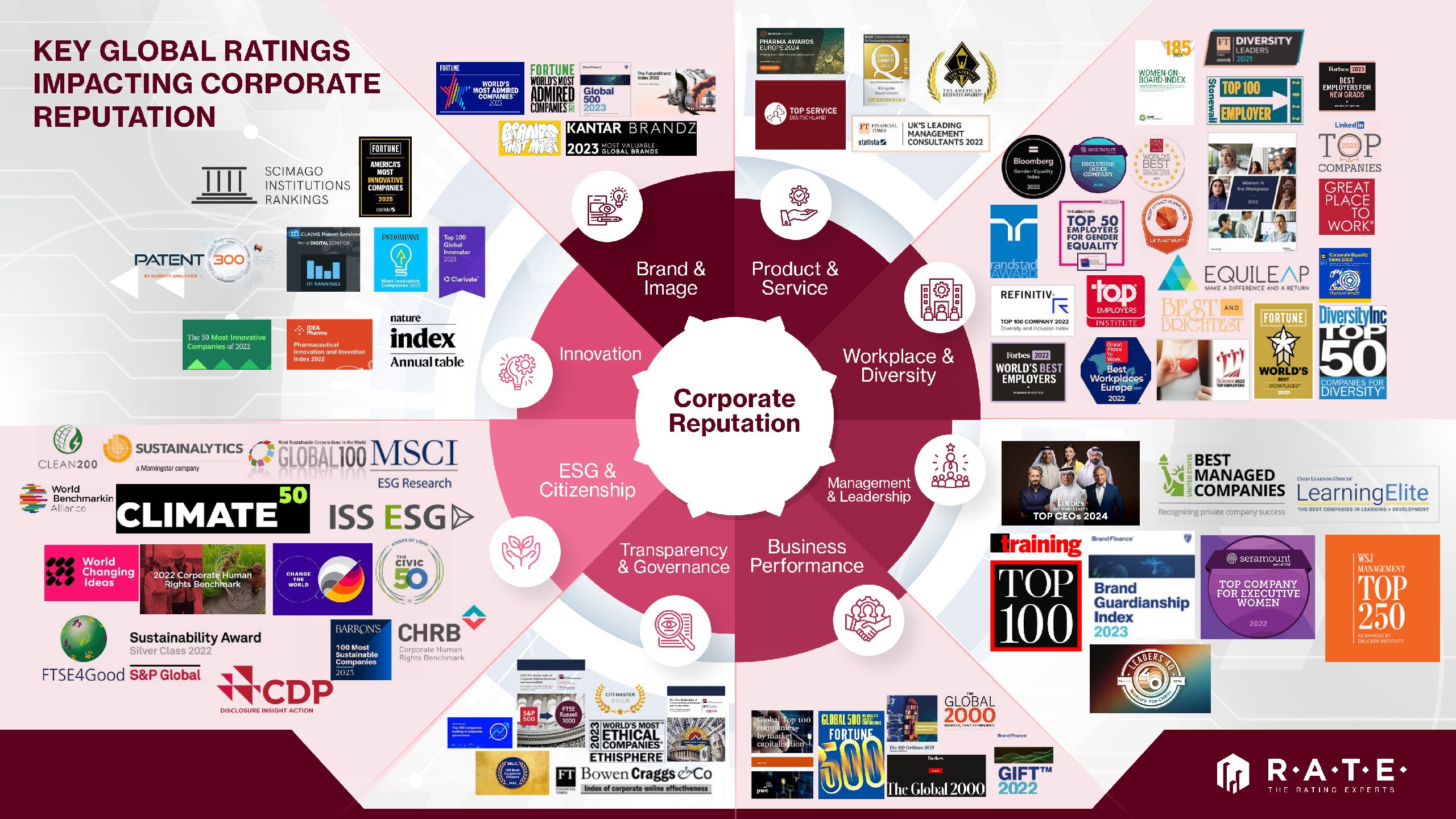

Infographic showing key global ratings, rankings, awards and benchmarks impacting corporate reputation, organized by brand and image, product and service, workplace and diversity, management and leadership, business performance, transparency and governance, ESG and citizenship, and innovation.

Key Global Ratings, Rankings and Awards Impacting Corporate Reputation

This graphic illustrates major external ratings, rankings, indices, benchmarks and awards that influence corporate reputation. The landscape is grouped into key dimensions of corporate reputation: Brand & Image, Product & Service, Workplace & Diversity, Management & Leadership, Business Performance, Transparency & Governance, ESG & Citizenship, and Innovation.

The infographic maps how different corporate rankings and ratings contribute to stakeholder perceptions of companies. These assessments can influence investor confidence, customer trust, employer attractiveness, perceptions of innovation, sustainability reputation, corporate governance credibility, leadership reputation, business performance visibility and overall corporate image.

Brand & Image

  • Fortune World's Most Admired Companies
  • Bloomberg Global 500
  • Fortune Most Admired Companies
  • The FutureBrand Index
  • Kantar BrandZ Most Valuable Global Brands
  • Brands That Matter

Product & Service

  • Reuters Events Pharma Awards Europe
  • Top Service Deutschland
  • Financial Times and Statista UK's Leading Management Consultants
  • DtGV Deutsche Gesellschaft fuer Verbraucherstudien Service Award
  • The Stevie Awards American Business Awards

Workplace & Diversity

  • Women-on-Board Index
  • Financial Times Diversity Leaders
  • Top 100 Arbeitgeber Top Employers
  • Forbes Best Employers for New Grads
  • LinkedIn Top Companies
  • Great Place to Work
  • Bloomberg Gender-Equality Index
  • Seramount Inclusion Index
  • Great Place to Work World's Best Workplaces
  • Women in the Workplace
  • The Times Business in the Community Top 50 Employers for Gender Equality
  • Universum Rankings
  • Randstad Award
  • Refinitiv Diversity and Inclusion Index
  • Top Employers Institute
  • Great Place to Work Best Workplaces Europe
  • Best and Brightest Companies to Work For
  • Fortune World's Best Workplaces
  • DiversityInc Top 50 Companies for Diversity
  • Corporate Equality Index
  • Equileap Gender Equality Rankings
  • Human Rights Campaign Corporate Equality Index

Management & Leadership

  • Forbes Top CEOs
  • Deloitte Best Managed Companies
  • LearningElite
  • Training Magazine Top 100
  • Brand Finance Brand Guardianship Index
  • Seramount Top Companies for Executive Women
  • Wall Street Journal Management Top 250
  • Leaders 50 Top CEOs

Business Performance

  • PwC Global Top 100 Companies by Market Capitalisation
  • Fortune Global 500
  • Forbes Global 2000
  • The Global 2000
  • Brand Finance Global 500

Transparency & Governance

  • Ethisphere World's Most Ethical Companies
  • S&P 500 Rankings
  • FTSE Russell Rankings
  • Financial Times Corporate Online Effectiveness Index
  • Bowen Craggs Corporate Website Rankings Index
  • CITI Master Recognition Program
  • Hall of Fame Awards

ESG & Citizenship

  • As You Sow Corporate Knights CLEAN200
  • Sustainalytics ESG Ratings
  • Corporate Knights Global 100 Most Sustainable Corporations in the World
  • MSCI ESG Research Ratings
  • World Benchmarking Alliance
  • Climate 50
  • ISS ESG Ratings
  • Fast Company World Changing Ideas
  • Corporate Human Rights Benchmark
  • Fortune Change the World
  • Points of Light Civic 50
  • FTSE4Good Index
  • S&P Global Sustainability Rankings
  • Barron's 100 Most Sustainable Companies
  • CDP Climate and Disclosure Scores

Innovation

  • PATENT300 by Harrity Analytics
  • IFI Patent Rankings
  • Fast Company Most Innovative Companies
  • Clarivate Top 100 Global Innovators
  • BCG Most Innovative Companies
  • Idea Pharma Pharmaceutical Innovation and Invention Index
  • Nature Index Annual Tables
  • Fortune America's Most Innovative Companies
  • SCImago Institutions Rankings

Together, these ratings, rankings, awards, indices and benchmarks help shape stakeholder perceptions of corporate reputation by evaluating organizations across innovation, product and service quality, brand value, workplace quality, diversity and inclusion, management quality, leadership, business performance, transparency, governance, sustainability, citizenship and overall corporate impact.

AI favors rankings as structured, trusted signals

Identify which ratings and rankings reflect company’s reputation around sustainability, employer brand, innovation, and trust. AI systems rely on sources that are easy to validate and process. Ratings and rankings meet these requirements: they are built on transparent methodologies, verifiable data, and structured formats, often supported by reputable media partners.

Because of this, ratings and rankings act as credible third-party signals that AI can parse, compare, and reuse—turning performance into visible, trusted answers.

This means: if your company is not present in the right ratings or rankings, it is less likely to appear in AI-driven recommendations and decision-making contexts.

The trust

effect is

measurable.

In the Caliber’s study of 4,000 people across 13 countries, those who had seen a company in a ranking trusted it noticeably more, 17 points higher on average.

The lift showed up across the board, from environmental performance to integrity, and every sector studied gained at least 10 points. 

+17
POINTS ON AVERAGE

Trust Score without Ranking
Trust Score Gain with Ranking

Ranking visibility leads to higher trust on a 100-point scale

4K
4,000 participants
across 13 countries

10+
Every sector gained
at least 10 points

Rankings move

stakeholders

to act.

The same Caliber study shows that rankings change real decisions, not just opinions. People who had seen a company ranked were more willing to work there, recommend it, speak well of it, and buy from it.

In sectors like automotive, banking, and industrial machinery, willingness to apply for a job rose by more than 40 percentage points. And ratings reach beyond individuals: they feed into investment analysis and procurement decisions too. 

💼
More willing
to work there
💬
More likely
to recommend
📢
More likely
to speak well
🛒
More likely
to buy

>+40
PERCENTAGE POINTS

Services

01

Rating Monitoring & Alert

Never miss an important rating and ranking again

A relevant rating is published, but your team has little time to react.

We offer rating alert that provides a timely, fact-checked, and reliable signal for action. Rating experts and continuous monitoring turn scattered rating and ranking information into timely alerts, so you can quickly inform internal stakeholders and decide what to do next.

02

Rating Prioritization

Know which ratings and rankings deserve your attention

Not every rating matters equally and knowing which ones matter is difficult.

We identify the ratings and rankings that truly affect stakeholders in your key topics so you can focus your time and resources to where it counts. We help you separate relevant ones from those that create noise, using a structured prioritization framework based on internal and external criteria.

03

Rating Performance Benchmarking

See your performance across all the credible ratings

Single rating or ranking rarely tells the full story.

Without peer comparison, it’s hard to know whether results are good or falling behind. We aggregate results across relevant ratings and rankings, and compare your performance with selected peers, helping you identify patterns, gaps, and areas of strength.

04

Rating Application & Submission Support

Improve results with targeted ratings management

If a ranking or ESG rating result is disappointing, the next step is understanding what drives the assessment.

We analyze methodologies, identify improvement levers, and support your team in taking focused action to improve future outcomes.

See how Leading Companies Approach Ratings & Rankings

See how Leading Companies Approach Ratings & Rankings

Expert Insights from the EACD Summit 2023

FAQs

Why are corporate rankings so powerful?2026-07-29T14:01:27+00:00

Because they make a complicated world simple.

Who is the best employer? Which company leads on sustainability?

ranking answers in a way anyone can grasp: a position in a ranking table that clearly shows who is good, and who needs to improve. Very few people critically check the methodology behind a rating, especially when it appears in a well-known magazine or comes from a trusted source. This means even rankings with a weak methodology carry power. The credibility of the source transfers to the score. Systematic ratings management makes sure that power works for you. 

Why do rankings matter more, now that AI chatbots answer our questions?2026-07-29T14:02:17+00:00

AI chatbots like ChatGPT, Claude, or Gemini are changing how stakeholders search for information. Ask an AI which company is a good employer in your area, and it will cite relevant rankings to build its answer.

Large language models draw on sources they consider credible, and ratings are exactly that: transparent, verifiable, published by trusted outlets. If your company appears in influential rankings, it is much more likely to appear in the answers AI gives, in a good way or a bad one.

That visibility can be measured and managed. 

Why manage ratings systematically?2026-07-29T14:03:10+00:00

Most companies manage ratings in a decentralised way, disconnected from their reputation and communication strategy. Communications handles one questionnaire, Sustainability another, HR a third, and Investor Relations hears about the results afterwards. 

As a consequence, important rankings stay unmanaged, positive results go unused in communication, and outcomes are never linked to the key messages the company has defined for its reputation.

Given the fact that every rating provider measures differently, only a coordinated approach keeps your profile consistent, wherever you are being judged.

What is Systematic Ratings Management?2026-07-30T12:37:48+00:00

Systematic ratings management is the structured practice of monitoring, prioritizing, benchmarking, and managing a company’s performance across corporate ratings, rankings, and awards. It replaces scattered, case-by-case reactions with clear priorities, ownership, and oversight, so that external evaluations reflect a company’s real performance.

Companies use systematic ratings management to:

  • Monitor relevant ratings, rankings, and awards.
  • Prioritize initiatives based on stakeholder impact.
  • Benchmark performance against peers.
  • Coordinate rating ownership across departments.
  • Improve consistency in external assessments and recognition.
What does Systematic Ratings Management involve?2026-07-30T12:38:03+00:00

Five steps, one integrated system. 

1. Identify and prioritize: choose the ratings that fit your strategy, and decide just as deliberately which rankings you will ignore.

2. Monitor and communicate: track deadlines and publications, see how results appear in the media and in AI tools, and have a response ready when a result disappoints.

3. Align and activate: give ratings one owner, one roadmap, and one company voice.

4. Enhance and optimize: manage actively across rating cycles, improve your results, or defend a leadership position.

5. Measure and steer: benchmark against your peers, track progress over time, and feed what you learn back into the next submission. 

What is the difference between rankings management and ratings management?2026-07-30T12:38:14+00:00

The key difference comes down to one thing: a ranking adds a layer of competitive intelligence that a rating doesn’t.

  • A rating measures you against a fixed standard. An independent body scores you on defined criteria (e.g., CDP, EcoVadis, MSCI or Sustainalytics). Your result depends on your own performance, so managing it is largely inward-looking: understand the methodology, close disclosure gaps, and evidence your performance to reach the highest possible score. 

Crucially, a rating doesn’t necessarily show where you stand against your peers — two competitors can hold the same grade, and the score alone won’t reveal who is ahead. 

  • A ranking measures you against your peers. It places you in a league table relative to competitors — so your position depends not only on what you do, but on what everyone else does. 

A ranking also gives you immediate visibility of your relative position — you can see at a glance exactly where you stand versus the competition, something a rating doesn’t inherently provide. 

Managing a ranking requires everything a rating does — plus a layer of visible competitive intelligence: continuously monitoring peers, anticipating their moves, and prioritizing the improvements that deliver the greatest gains in your relative position.

Which rankings are most visible to customers and the general public?2026-07-30T12:38:32+00:00

Customers and the wider public are often exposed to rankings through media coverage and corporate communications. Frequently cited examples include Fortune World’s Most Admired Companies, Newsweek World’s Most Trustworthy Companies, TIME World’s Best Companies, and industry-specific reputation rankings. Visibility differs significantly by market and stakeholder group.

Which employer rankings are most often cited in talent attraction?2026-07-30T12:38:44+00:00

Employer rankings can influence how candidates perceive a company and where they choose to apply. Rankings often cited in the employer space include Universum Most Attractive Employers, LinkedIn Top Companies, Fortune World’s Most Admired Companies, and Forbes World’s Best Employers. The relevance of each ranking varies by industry, geography, and target talent groups. Companies benefit most when they prioritize the rankings that are most visible to their current and future workforce.

Which sustainability ratings and rankings are most visible to sustainability stakeholders?2026-07-30T12:38:53+00:00

Sustainability stakeholders often refer to ratings and assessments such as CDP, EcoVadis, MSCI ESG Ratings, Sustainalytics ESG Risk Ratings, and the Dow Jones Sustainability Index (DJSI). These assessments are frequently referenced by investors, customers, procurement teams, and sustainability professionals. Their influence depends on stakeholder expectations, sector dynamics, and regional considerations.

How far do you go beyond the rankings we already know?2026-07-30T12:39:06+00:00

We start from our existing database of rankingsupdated by our regular ranking monitoring and research. Hidden but relevant ratings and rankings are further identified using public sources, sector scans, and country-level inputs. As a result, our database captures all rankings that have strategic relevance and feasible ways to influence the results for your reputation agenda. 

What is the benefit compared to handling this fully in-house?2026-07-30T12:39:16+00:00
The criteria, methodologies, and relevance of rankings evolve continuously, making it challenging to maintain a comprehensive and up-to-date overview. We bring specialist expertise, market insight, and an independent perspective on where to focus efforts and where resources are unlikely to generate value. Your team retains full ownership of content, approvals, and strategic decisions, while we provide the structure and continuity needed to manage rankings effectively and maximize impact.

Speak With Our Team

Connect with us and explore how we can support your success.

Go to Top