
Human Rights Due Diligence: Why policy work is not enough
Your suppliers have signed a code of conduct. Risk assessments are complete, and audit reports are coming in. Yet a difficult question remains: do you know where people are most at risk and whether your measures are making a difference?
For the teams responsible for human rights due diligence, the challenge is practical. Visibility can fade beyond direct suppliers. Information can be difficult to verify. And the expectations placed on suppliers may not be reflected in the company’s own purchasing decisions.
The OECD’s 2026 Responsible Business Outlook highlights that last disconnect: only 7% of the large listed companies assessed report integrating their social supply chain policies into purchasing practices. The finding is based on public disclosures, but it raises an important management question: how closely are human rights commitments connected to everyday business decisions?
These questions matter for companies headquartered in the EU, Switzerland, the Middle East and elsewhere. Legal obligations vary, while risks to people arise through the work companies do and the relationships they depend on.
For Pia Rudolfsson Goyer, finding answers means getting closer to that reality: listening to affected workers, understanding what suppliers are being asked to deliver and checking whether measures reach the people they are intended to protect.
In this interview, she explains where companies overlook risks, why standard supplier questionnaires can fall short and how to move from identifying a problem to taking meaningful action.
Seeing the value beyond compliance
With so much attention on changing European sustainability requirements, it is easy for the discussion to become a legal one. What do companies miss when they look at human rights due diligence only through that lens?
Pia: They miss the opportunity to understand their risks before those risks turn into incidents that harm people. Human rights due diligence is risk based. It helps you become aware of where problems may arise and think about how to address them before something happens.
Human rights and worker-related risks can also have financial consequences. More actors are recognising that, including banks and insurers. Being able to demonstrate that you understand and manage these risks can matter in those relationships.
There is also something valuable in how you do the work. Companies that involve stakeholders in identifying risks and deciding how to manage them can build trust and pride, particularly among employees. That is another benefit companies can overlook when their focus is only on compliance.
Looking closer to home
When companies begin looking for human rights risks, where do they tend to miss things?
Pia: Many companies based in Europe assume that they do not have human rights risks themselves. They think the risks are somewhere far away in the supply chain and that they can handle them through contracts, pushing responsibility further down the chain.
Some also misunderstand what due diligence is for. They approach it as a way to protect the company, when its purpose is to prevent the company from negatively affecting people.
That misunderstanding can make it harder to see what is happening close to home. There are workers who remain effectively invisible unless you know where to look. Think about the people in laundries washing hotel linens and towels, those working in car washes in car parks, or those delivering online orders at night. These workers can be underpaid and lack social insurance protection.
You need to look at the people behind those services, rather than assume that operating in Europe means the risks are elsewhere.
Finding out what happens on the ground
Those examples make the issue very tangible. Yet many companies already have policies, supplier codes and audits. How do they find out whether those measures actually make a difference?
Pia: By staying in close contact with the people affected. Companies should engage with rights holders and their representatives, including trade unions, worker committees and local civil society organisations.
Worker interviews, grievance mechanisms and on-site visits can help you understand whether measures reach the right groups and have the intended effect. You have to stay close to what is happening on the ground.
And you cannot do everything alone. Suppliers, partners and others can influence how people are affected, so you need to work with them. It is also important to make sure that your own actions do not undermine the measures you are trying to put in place.
Is there a familiar approach that gives companies more reassurance than it should?
Pia: Supplier questionnaires. Companies send them out to map risks and often use them as evidence that they are taking action. But sending the same questionnaire to everyone is not an effective way to understand what is happening.
Questionnaires need to be targeted and tailored to different supplier groups. Otherwise, you can alienate long-standing suppliers while creating a huge amount of material that you struggle to process or use.
In my experience, this is one of the most frequently used measures, but also one of the least effective when used in that way.
Asking what kind of buyer you are
You mentioned that a company’s own actions can undermine its measures. What does that look like in procurement?
Pia: Fast fashion is a clear example. Orders change at short notice, but delivery times remain tight. That can directly affect workers, who may be required to work overtime with very little notice, sometimes without extra pay.
Companies put requirements and expectations into supplier contracts. But the relationship also requires them to act as decent buyers.
That means planning ahead and making changed orders the exception. Procurement needs to work with designers, trend analysts and others who make decisions about the final product. Their decisions affect what suppliers are being asked to deliver.
This is relevant beyond textiles. You see similar issues in other manufacturing industries and in construction, where changes to orders can also have unfortunate consequences for workers.
Understanding what lies beyond the first tier
The EU Forced Labour Regulation will apply from 14 December 2027. It also matters for products sourced outside Europe. Where should companies start preparing?
Pia: The first thing to understand is that looking only at your direct suppliers is not enough. You need to understand where forced labour risks may arise further along the supply chain.
Learning to apply risk-based human rights due diligence gives you a useful starting point. It helps you map the supply chain and identify where you need to look more closely.
Companies that have already done that mapping and engaged with suppliers presenting particular risks because of their location or sector have a stronger basis for the work.
And when visibility further down the supply chain is limited?
Pia: You need to build your knowledge of the sector. Understand where the products are likely to be sourced and where the highest risks are. Working with other companies can help you develop that understanding.
You can also ask direct suppliers to show where they source from. That may be easier where you are an important customer, or where you work with other buyers to increase your influence.
It is also important to think ahead about how you would address the underlying problem if a product were withdrawn. Having a remediation plan in place is part of that preparation.
The EU Forced Labour Regulation covers products regardless of their origin when they are placed on, made available on or exported from the EU market. It introduces a product prohibition; it does not create a new general audit or reporting obligation. Due diligence can support preparation but does not guarantee market access. (Source: European Commission, Forced Labour Regulation)
Turning findings into decisions
Some companies have already identified their main risks, but then get stuck. How do they move from knowing the problem to doing something useful about it?
Pia: You first need to understand the risk properly and what it could mean for people if it becomes an actual negative impact. From there, you can prioritise based on severity and likelihood and direct resources where they are most needed.
The measures will depend on the risk and the company’s relationship to it. Is it happening in your own operations, in the local community or in the supply chain? What role does the company play?
If you are causing harm, you need to stop. If you are contributing to it, you need to address your contribution and use your influence to prevent or mitigate the remaining impact. Working with suppliers and partners is also important when addressing risks in the supply chain.
The UN Guiding Principles and the OECD Guidelines provide useful guidance. But within the company, the next step is to bring the relevant functions together and decide which measures are appropriate. You can also learn from how other companies have managed similar risks.
Starting with the work
If you could change just one thing about how companies approach human rights due diligence, what would it be?
Pia: Do not think of this work as reporting. It is not. To have something to report on, you need to do the work first.
Companies that are serious about this come to me and ask, “Where do we start?”
My answer is that we start by mapping the risks, or even the negative impacts, that they have. From there, we can formulate the policy, establish routines and put in place relevant measures that we can be confident actually work. Then we can report on that work.
MOST POPULAR INSIGHTS


SHARE THIS ARTICLE
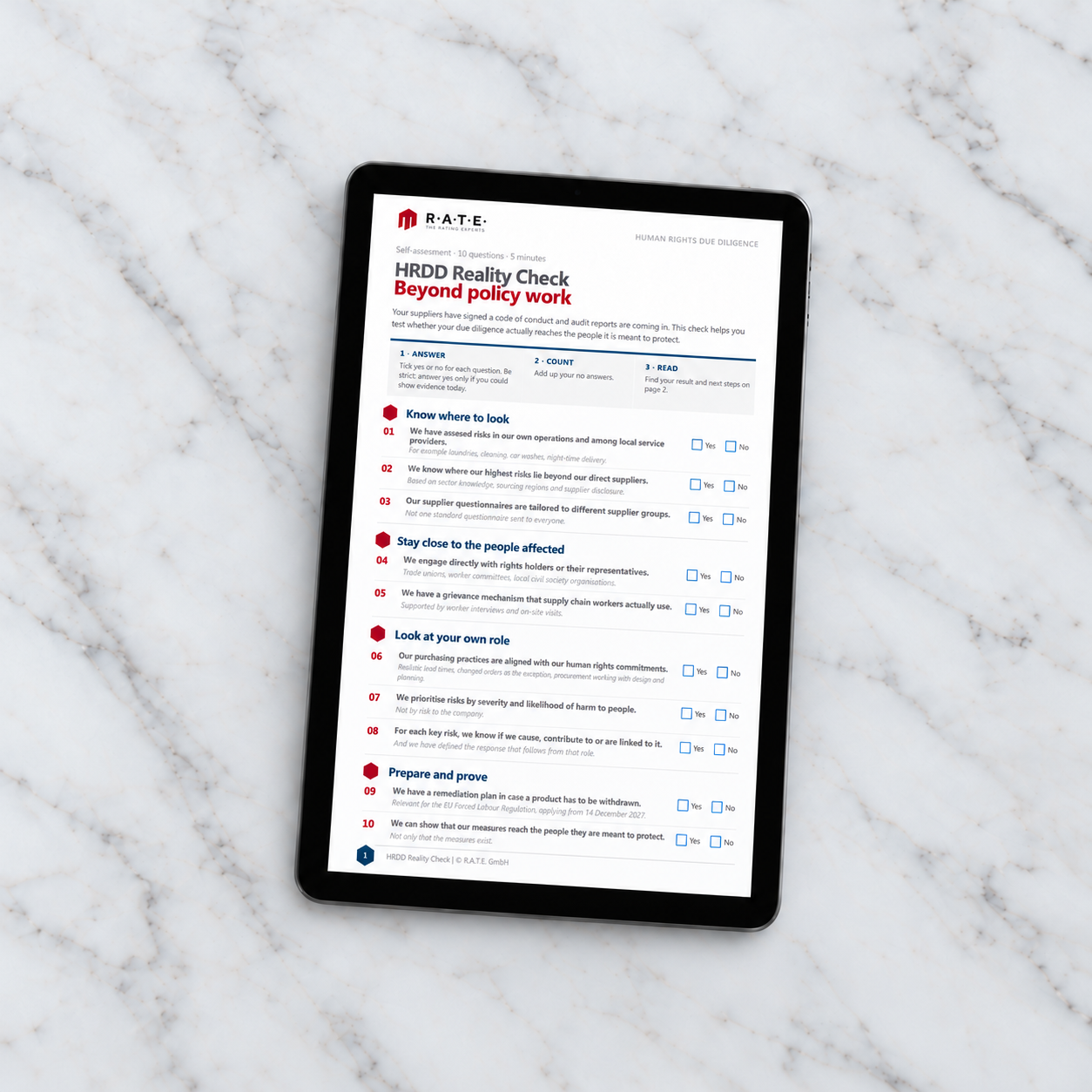
Test Your Human Rights Due Diligence in 5 Minutes
Our free Human Rights Due Diligence Reality Check walks you through 10 questions across four areas, from mapping risk to proving impact, so you can see exactly where your approach holds up and where it doesn’t.
How R.A.T.E. Helps You Move Beyond Policy Work
Every question in this checklist points to the same gap: human rights due diligence that looks complete on paper but doesn’t reach the people it’s meant to protect. We help you find where that gap is, prioritize what matters most, and build measures you can actually prove, not just policies you can report on.
Authors

Share This Story, Choose Your Platform!
Related articles
Nothing Found