

Share This Story, Choose Your Platform!
We’ve all seen them—“Most Innovative Brands,” “Top Employers,” “Greenest Companies.” Corporate rankings are everywhere, and for good reason. They boost visibility, generate positive publicity, and now, they’re playing a bigger role than ever in shaping how companies are perceived by their stakeholders.
As AI tools become a primary way in which people search for answers, rankings gain additional weight. Unlike traditional search engines, AI doesn’t just list links— it delivers answers built on data signals that show trust, credibility, and relevance. Rankings fit that bill perfectly. Recent licensing deals between AI providers and major media groups reinforce this trend, making their rankings more likely to surface in AI answers.
Trust Scores Jump When Rankings Are Seen
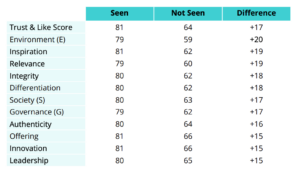
Caliber’s research across 4,000 people in 13 countries found that when someone had seen a familiar company in a ranking in the past year, their perception of it improved dramatically. On average, Trust & Like Scores were 17 points higher (81 vs. 64) among people who had seen the company ranked.
The effect went far beyond trust. Respondents perceived ranked companies more positively across a range of brand and reputation attributes, from environmental impact (+20) to inspiration and relevance (both +19) to integrity (+18).
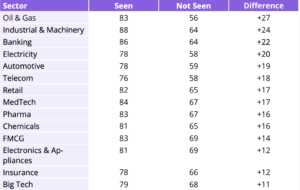
And this wasn’t limited to specific industries. Every sector saw gains of at least +10 points, with Oil & Gas, Banking, and Industrial sectors all seeing trust lifts of 20 points or more.
Rankings Influence Stakeholder Behavior
Rankings don’t just improve perceptions of brand and reputation. They influence what people do.
Among those who had seen a company in a ranking, significantly more said they would:
- Consider working there—a 36-point jump;
- Speak positively about the company—up 35 points;
- Recommend it to others—up 34 points;
- Consider buying from it—up 31 points.
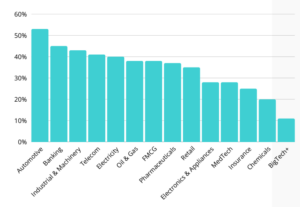
These shifts in behavior were most dramatic in sectors like Automotive, Banking, and Industrial Machinery, where “employment consideration” increased by more than 40 percentage points.
Our research also shows that younger, professional audiences are more likely to recall seeing rankings, while in Europe—where baseline reputation scores tend to be lower— rankings offer a valuable opportunity to shift perception.
In short, being visible in rankings doesn’t just make you look good. It moves people—as job seekers, customers, and advocates.
Why This Matters in the AI Era
AI is changing how people find information online. By 2028, Gartner expects search engines to lose over half their traffic to AI tools. Unlike search engines, AI assistants like ChatGPT don’t list links— they summarize trusted, relevant content. To do this, they rely on sources aligned with Google’s E-EA-T framework (Experience, Expertise, Authority, Trust).
Rankings fit this model well. They use transparent methods, verifiable data, and come from trusted publishers or research groups. Their structured format also makes them easy for AI to process, update, and compare over time. Licensing deals with major outlets like the Financial Times and News Corp will only increase the visibility of this content.
In short, if your company appears in a trusted ranking, it’s more likely to show up in AI-generated answers to key questions—like “Is this company a good place to work?” or “Which companies are leading on sustainability?”
That gives rankings new strategic value. They aren’t just marketing tools anymore. They’re becoming trust signals for algorithms and humans alike.
What Companies Should Do
To make the most of rankings in this new landscape, here are four practical steps:
- Prioritize relevant rankings Focus on ones that are credible, relevant to your stakeholders, and aligned with your strategic goals—whether that’s employer branding, ESG leadership, or innovation.
- Monitor rankings through Share of Model Assess which rankings AI tools highlight in relation to your key messages and strategic topics—and whether your positioning supports your narrative.
- Use rankings as a signal—and a story Don’t just state the ranking. Use it as a hook to highlight your progress, purpose, or innovation. And make sure it shows up where it matters—in job posts, career pages, social media, and PR. This is especially effective when engaging younger or professional stakeholders.
- Measure the reputational impact Stakeholder-tracking platforms can reveal real-time shifts in your reputation and provide actionable insights about what moves the needle, including the impact of rankings—especially in markets with lower baseline levels of trust, such as Europe.
The Bottom Line
In a low-trust world, building credibility is harder than ever. And as AI takes a bigger role in shaping what people see and believe about your company, it’s essential to feed the machine with signals that convey trust.
Rankings do exactly that. They’re visible, verifiable, and valued—by people and algorithms alike. And that makes them one of the most powerful tools available for companies looking to build trust, shape stakeholder perceptions, and stand out in a noisy digital world.